
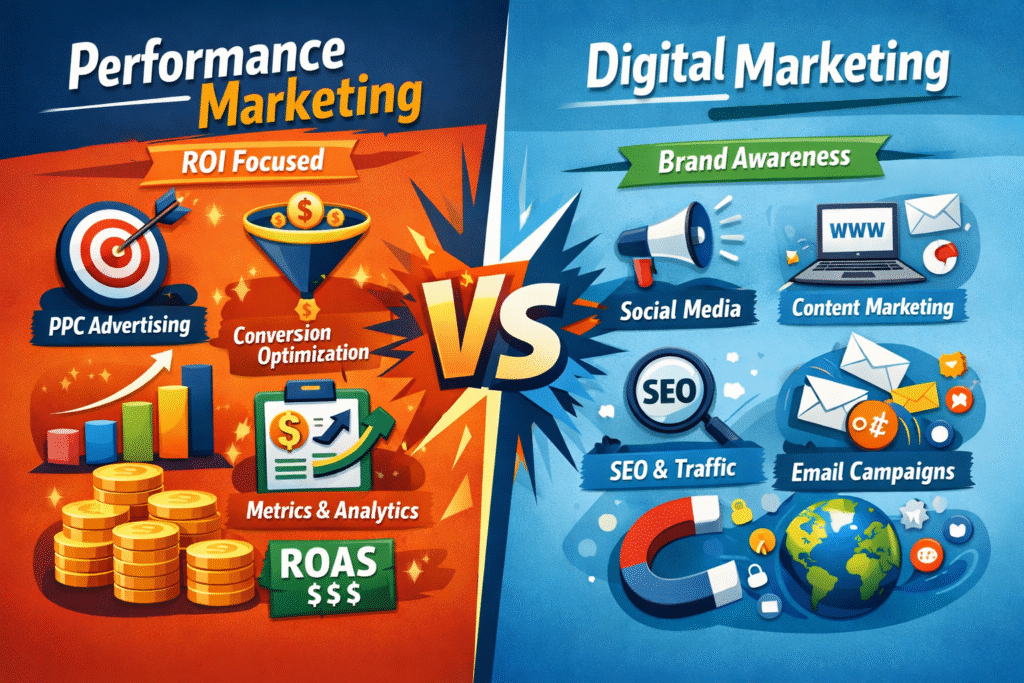
Performance Marketing vs Digital Marketing: Choosing the Right Approach for Your Business
In today’s fast-paced digital world, businesses often struggle to decide between performance marketing and digital marketing. While both aim to boost online visibility and drive sales, they differ in approach, cost, and results. If you’re wondering which strategy aligns best with your business goals, this guide will help you understand the key differences between performance marketing vs digital marketing, their pros and cons, and how to choose the right one for your business. What is Digital Marketing? Digital marketing is an umbrella term for all online marketing efforts. It includes strategies like: Key Features of Digital Marketing ✅ Brand Awareness: Helps businesses build a strong online presence. ✅ Long-Term Growth: Focuses on sustainable customer relationships. ✅ Multi-Channel Approach: Uses various platforms (Google, Facebook, LinkedIn, etc.). ✅ Cost-Effective: Can be scaled based on budget. Example: A fashion brand using Instagram ads, SEO blog posts, and email newsletters to attract and retain customers. What is Performance Marketing? Performance marketing is a results-driven subset of digital marketing. Businesses only pay when a specific action is completed, such as: Key Features of Performance Marketing ✅ Pay-for-Results Model: No upfront costs; payment is tied to performance. ✅ Highly Measurable: Uses real-time analytics to track ROI. ✅ Low Risk: Ideal for startups and small businesses with limited budgets. ✅ Targeted Campaigns: Focuses on high-intent audiences. Example: An e-commerce store running Google Ads where they only pay when a user clicks and makes a purchase. Performance Marketing vs Digital Marketing: Key Differences 1. Primary Goal 2. Payment Model 3. Risk Level 4. Best Suited For 5. Measurement Metrics 6. Time to See Results 7. Flexibility Which is Better: Performance Marketing or Digital Marketing? Choose Digital Marketing If: ✔ You want to build brand authority and long-term customer loyalty. ✔ You have a larger budget and can invest in multiple channels. ✔ Your business focuses on content, storytelling, and engagement. Choose Performance Marketing If: ✔ You need immediate results with a limited budget. ✔ Your goal is direct sales, leads, or app installs. ✔ You prefer low-risk, high-reward campaigns. Best Approach? Use Both! Many successful businesses combine both strategies: Example: A SaaS company uses SEO and content marketing to attract leads and Google Ads (CPA model) to convert them into paying customers. Performance Marketing vs Digital Marketing: Which Gives Better ROI? Digital Marketing ROI Performance Marketing ROI Data Insight: According to a 2025 report by HubSpot, 63% of businesses using performance marketing saw a 30%+ increase in conversions within the first quarter. How to Choose the Right Strategy for Your Business? Step 1: Define Your Goals Step 2: Analyze Your Budget Step 3: Understand Your Audience Step 4: Test and Optimize FAQs About Performance Marketing vs Digital Marketing 1. Is performance marketing a part of digital marketing? Yes! Performance marketing is a subset of digital marketing that focuses on measurable results. 2. Which is more expensive: digital marketing or performance marketing? Digital marketing can be costly upfront (SEO, content creation), while performance marketing is pay-as-you-go. 3. Can small businesses benefit from performance marketing? Absolutely! Performance marketing is ideal for small businesses due to its low-risk, high-reward nature. 4. How long does it take to see results? 5. Should I hire an agency for performance marketing? If you lack expertise, hiring a performance marketing agency can help optimize campaigns for better ROI. Conclusion Choosing between performance marketing vs digital marketing depends on your business goals, budget, and timeline. Start by testing both strategies, track your results, and optimize for success. Which strategy are you leaning toward? Let me know in the comments!