

In today’s digital-first world, search engine marketing (SEM) is the backbone of online visibility. Whether you’re a startup, a small business, or an established enterprise, understanding the types of search engine marketing can make or break your digital success.
But what exactly is SEM? How does it differ from SEO? And most importantly, which types of search engine marketing aligns with your business goals?
In this comprehensive guide, we’ll explore:
- The core types of search engine marketing
- How each type works and its unique benefits
- Real-world examples and success stories
- How to choose the right SEM strategy for your business
By the end, you’ll have a clear roadmap to leverage SEM effectively and drive measurable results.
What is Search Engine Marketing (SEM)?
Search engine marketing (SEM) is a digital marketing strategy aimed at increasing a website’s visibility on search engine results pages (SERPs) through paid and organic efforts. While SEO (Search Engine Optimization) focuses on organic rankings, SEM encompasses both paid advertising (PPC) and organic optimization.
Why SEM Matters in 2026
- 93% of online experiences begin with a search engine (HubSpot).
- Google processes over 8.5 billion searches per day (Internet Live Stats).
- Businesses make $2 for every $1 spent on Google Ads (Google Economic Impact Report).
Given these statistics, ignoring SEM means missing out on a massive audience. But not all types of search engine marketing are created equal. Let’s break them down.
The Core Types of Search Engine Marketing
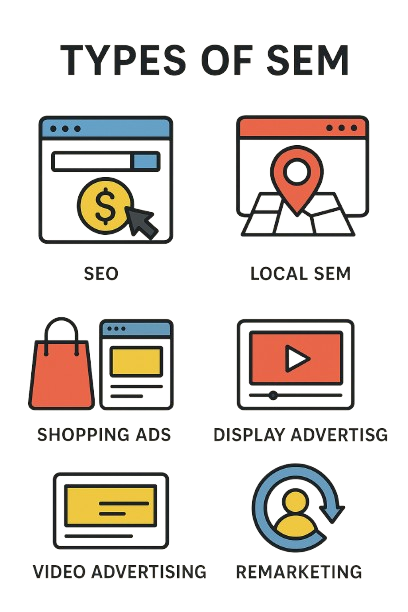
1. Search Engine Optimization (SEO)
SEO is the foundation of SEM. It involves optimizing your website to rank higher in organic (non-paid) search results.
How SEO Works
- On-Page SEO: Optimizing content, meta tags, headers, and internal links.
- Off-Page SEO: Building backlinks, social signals, and brand mentions.
- Technical SEO: Improving site speed, mobile-friendliness, and crawlability.
Pros of SEO
✅ Long-term results – Once ranked, organic traffic is sustainable. ✅ Cost-effective – No direct cost per click (CPC). ✅ Builds credibility – Users trust organic results more than ads.
Cons of SEO
❌ Time-consuming – Results take 3-6 months. ❌ Algorithm changes – Google updates can impact rankings.
Best For:
- Businesses with a long-term growth strategy.
- Brands focusing on authority and trust.
2. Pay-Per-Click Advertising (PPC)
PPC is a paid SEM strategy where advertisers pay each time a user clicks on their ad. The most popular platform is Google Ads, but Bing Ads and social media ads (Facebook, LinkedIn) also fall under PPC.
How PPC Works
- Keyword Bidding: Advertisers bid on keywords relevant to their business.
- Ad Auction: Google determines ad placement based on bid amount and ad quality.
- Landing Pages: Users are directed to a optimized page after clicking.
Pros of PPC
✅ Instant visibility – Ads appear as soon as the campaign is live. ✅ Targeted reach – Ads can be tailored by location, demographics, and device. ✅ Measurable ROI – Track conversions, clicks, and impressions in real-time.
Cons of PPC
❌ Costly – Competitive keywords can have high CPC. ❌ Requires expertise – Poorly managed campaigns waste budget.
Best For:
- Businesses needing quick traffic and leads.
- E-commerce stores and time-sensitive promotions.
3. Local Search Engine Marketing
Local SEM focuses on optimizing for geo-specific searches, helping businesses attract nearby customers.
How Local SEM Works
- Google My Business (GMB) Optimization: Claiming and optimizing your GMB listing.
- Local Keywords: Using location-based keywords (e.g., “best coffee shop in Mumbai”).
- Online Reviews: Encouraging customer reviews on Google and Yelp.
Pros of Local SEM
✅ High conversion rates – Local searches often lead to in-store visits. ✅ Less competition – Easier to rank for niche local terms. ✅ Mobile-friendly – 46% of all Google searches are local (Think with Google).
Cons of Local SEM
❌ Limited reach – Only targets users in a specific area. ❌ Requires consistent updates – Business details must stay current.
Best For:
- Brick-and-mortar stores (restaurants, salons, clinics).
- Service-based businesses (plumbers, electricians).
4. Shopping Ads (Google Shopping)
Shopping Ads are product-based ads that appear in Google’s Shopping tab. They display product images, prices, and store names.
How Shopping Ads Work
- Product Feed Submission: Upload product data to Google Merchant Center.
- Bid Management: Set bids for product groups.
- Ad Display: Ads appear when users search for related products.
Pros of Shopping Ads
✅ Visual appeal – Images attract more clicks than text ads. ✅ High purchase intent – Users are ready to buy. ✅ Competitive edge – Stand out in product searches.
Cons of Shopping Ads
❌ Complex setup – Requires Merchant Center and feed management. ❌ Costly for competitive products – Bidding wars can drive up CPC.
Best For:
- E-commerce businesses.
- Retailers with a large product catalog.
5. Display Advertising
Display Ads are visual banner ads shown on websites within the Google Display Network (GDN).
How Display Ads Work
- Targeting Options: Demographic, interest-based, or remarketing.
- Ad Formats: Static images, animated banners, or video ads.
- Placement: Ads appear on partner websites, YouTube, and Gmail.
Pros of Display Ads
✅ Brand awareness – Reaches a broad audience. ✅ Retargeting capabilities – Brings back past visitors. ✅ Creative flexibility – Use images, videos, and interactive ads.
Cons of Display Ads
❌ Lower click-through rates (CTR) – Users often ignore banners. ❌ Less intent-driven – Users may not be actively searching for your product.
Best For:
- Branding campaigns.
- Businesses with strong visual content.
6. Video Advertising (YouTube Ads)
Video Ads appear on YouTube and across the Google Display Network.
How Video Ads Work
- Skippable Ads: Users can skip after 5 seconds.
- Non-Skippable Ads: Must be watched in full (15-20 seconds).
- Bumper Ads: Short, non-skippable 6-second ads.
Pros of Video Ads
✅ High engagement – Video content is more memorable. ✅ Targeted reach – Ads can be shown to specific demographics. ✅ YouTube’s massive audience – 2.5 billion monthly users.
Cons of Video Ads
❌ Production costs – High-quality videos require investment. ❌ Ad fatigue – Users may skip or ignore repetitive ads.
Best For:
- Brands with engaging video content.
- Businesses targeting younger audiences.
7. Remarketing (Retargeting)
Remarketing targets users who previously visited your website but didn’t convert.
How Remarketing Works
- Pixel Tracking: A code snippet tracks visitors.
- Ad Display: Users see your ads as they browse other sites.
- Custom Audiences: Segment users based on behavior (e.g., cart abandoners).
Pros of Remarketing
✅ Higher conversion rates – Targets warm leads. ✅ Cost-effective – Focuses on users already interested in your brand. ✅ Personalized messaging – Tailor ads based on user behavior.
Cons of Remarketing
❌ Privacy concerns – Users may find it intrusive. ❌ Ad fatigue – Over-exposure can annoy users.
Best For:
- E-commerce stores with high cart abandonment.
- Service-based businesses with long sales cycles.

How to Choose the Right Type of Search Engine Marketing
With so many types of search engine marketing, how do you decide which one is right for your business? Here’s a step-by-step guide:
1. Define Your Goals
- Brand Awareness? → Display Ads, Video Ads
- Immediate Sales? → PPC, Shopping Ads
- Long-Term Growth? → SEO, Local SEM
2. Analyze Your Budget
- Low Budget? → SEO, Local SEM
- High Budget? → PPC, Shopping Ads, Video Ads
3. Understand Your Audience
- Local Customers? → Local SEM, Google My Business
- Global Reach? → SEO, PPC, Display Ads
4. Assess Your Resources
- In-House Team? → Manage PPC and SEO internally.
- Limited Expertise? → Hire an SEM agency.
5. Test and Optimize
- Run A/B tests for ads and landing pages.
- Track KPIs (CTR, conversion rate, ROI).
- Adjust strategies based on performance.
Real-World Success Stories
Case Study 1: E-Commerce Store Boosts Sales with Shopping Ads
Business: Online fashion retailer Strategy: Google Shopping Ads + Remarketing Result: 300% increase in sales within 3 months.
Case Study 2: Local Restaurant Dominates with Local SEM
Business: Family-owned restaurant Strategy: Google My Business + Local SEO Result: 50% more foot traffic and a 4.8-star rating.
Case Study 3: SaaS Company Scales with PPC
Business: B2B software provider Strategy: Google Ads + LinkedIn PPC Result: 200% increase in demo sign-ups.
Common SEM Mistakes to Avoid

- Ignoring Mobile Optimization – 60% of searches come from mobile devices.
- Neglecting Negative Keywords – Wasting budget on irrelevant clicks.
- Poor Landing Page Experience – High bounce rates hurt conversions.
- Not Tracking Conversions – Without data, you can’t optimize.
- Overlooking Local SEO – Missing out on nearby customers.
FAQs About Types of Search Engine Marketing
1. What is the difference between SEO and SEM?
SEO focuses on organic rankings, while SEM includes both organic (SEO) and paid (PPC) strategies.
2. How much does PPC advertising cost?
Costs vary by industry. Average CPC ranges from $1 to $50, depending on competition.
3. Can I do SEM without a website?
No, SEM requires a landing page for ads and SEO. However, you can use Google My Business for local visibility.
4. How long does it take to see results from SEO?
SEO is a long-term strategy. Expect to see results in 3-6 months with consistent effort.
5. Which type of SEM is best for small businesses?
Local SEM and PPC are ideal for small businesses due to lower costs and high ROI.
6. How do I measure SEM success?
Track KPIs like:
- Click-Through Rate (CTR)
- Conversion Rate
- Return on Ad Spend (ROAS)
- Organic Traffic Growth
Conclusion: Which Type of Search Engine Marketing is Right for You?
Choosing the right type of search engine marketing depends on your goals, budget, and audience. Here’s a quick recap:
- Need quick results? → PPC or Shopping Ads
- Building long-term authority? → SEO
- Targeting local customers? → Local SEM
- Boosting brand awareness? → Display or Video Ads
- Recapturing lost leads? → Remarketing
The best approach? Combine multiple SEM strategies for a holistic digital marketing plan.
Next Steps
- Audit your current SEM efforts.
- Identify gaps and opportunities.
- Start with one strategy, then expand.
- Monitor, optimize, and scale.
Final Thought: SEM is not a one-size-fits-all solution. Experiment, analyze, and refine your approach to stay ahead in the ever-evolving digital landscape.
What’s your biggest SEM challenge? Share in the comments below! 🚀